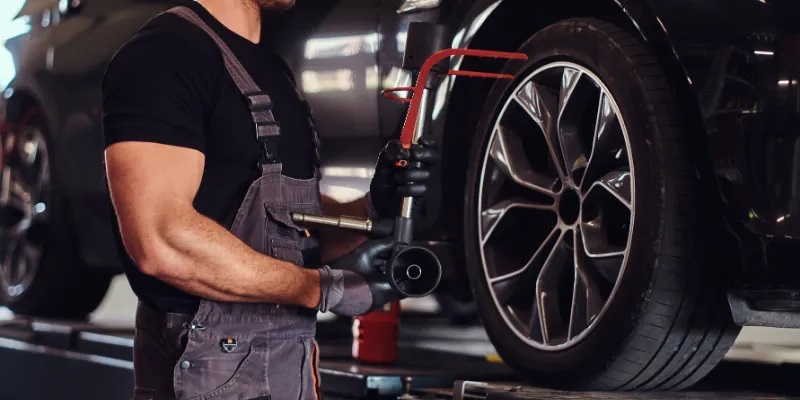
Wheel alignment and wheel balancing are two distinct maintenance services required to ensure vehicle safety and tyre longevity. While often performed together, they address different mechanical issues related to your car’s suspension and wheel assembly.
The primary difference is that wheel alignment adjusts the angles of the car tyres so they are parallel to each other and perpendicular to the ground, while wheel balancing corrects the uneven distribution of weight within the wheel and tyre unit.
Properly maintained wheels, such as high-quality CEAT tyres, ensure a smoother ride, better fuel efficiency and prevent the common issue of a car shaking at high speeds.
Wheel Alignment focuses on the suspension and the angle at which tyres touch the road. Wheel Balancing focuses on weight distribution within the tyre/wheel assembly to eliminate vibrations.
- Alignment: Corrects steering pull and uneven tyre wear.
- Balancing: Stops steering wheel vibration and “car shaking.”
- Maintenance: Both are essential for the standard tyre maintenance schedule 2026.
- Performance: Proper service extends the life of CEAT tyres.
What is Wheel Alignment?
Wheel alignment, also known as “tracking,” is a mechanical adjustment of the vehicle’s suspension system. It is not an adjustment of the tyres themselves, but rather the system that connects the vehicle to its wheels.
- Camber: The inward or outward angle of the tyre when viewed from the front.
- Toe: The extent to which your tyres turn inward or outward when viewed from above.
- Caster: The angle of your steering axis when viewed from the side.
What is Wheel Balancing?
Wheel balancing compensates for weight inconsistencies in the tyre and wheel combination. Even a tiny weight difference (as small as a few grams) can cause significant centrifugal force issues at high speeds.
- The Process: Technicians use a calibrated balancer to identify “heavy spots.”
- The Fix: Small lead or zinc weights are attached to the rim to offset imbalances.
- Result: A perfectly balanced wheel spins evenly without wobbling.
Comparison: Alignment vs. Balancing
| Feature | Wheel Alignment | Wheel Balancing |
| Primary Goal | Align tyres with the road and each other | Equalise weight around the wheel |
| Symptom of Issue | Car pulls to one side | Steering wheel or seat vibrates |
| Mechanical Focus | Suspension components | Tyre and rim assembly |
| Common Cause | Potholes, curbs, or worn parts | Normal tyre wear or losing a weight |
Why is My Car Shaking at High Speeds?
A car shaking at high speeds is the most common indicator that your wheels are out of balance. This vibration typically starts at around 50–60 mph (80–100 km/h) and becomes more intense as speed increases.
- Steering Wheel Vibration: Usually indicates the front wheels are unbalanced.
- Floor or Seat Vibration: Usually indicates the rear wheels are unbalanced.
- Impact on Tyres: Unbalanced wheels create “cupping” or “scalloping” wear patterns on car tyres, which can permanently damage the tread.
Standard Tyre Maintenance Schedule 2026
Following a standard tyre maintenance schedule 2026 is critical for vehicle efficiency. Modern vehicle sensors are highly sensitive to alignment deviations.
- Every 5,000 to 10,000 km: Rotate tyres and check balancing.
- Every 12 Months: Perform a full four-wheel alignment check.
- After New Tyre Installation: Always balance wheels when mounting new CEAT car tyres.
- Immediate Action: Seek service if you hit a deep pothole or notice steering pull.
Benefits of Regular Maintenance with CEAT Tyres
Using premium CEAT tyres provides a foundation for safety, but regular maintenance unlocks their full potential:
- Improved Fuel Economy: Aligned wheels reduce rolling resistance.
- Smoother Ride: Balanced wheels eliminate cabin noise and vibration.
- Safety: Correct alignment ensures predictable handling during emergency maneuvers.
- Component Longevity: Proper maintenance reduces stress on steering and suspension parts.
CEAT Tyre Range: Selection Guide
Selecting the right tyre from the CEAT tyre range ensures your vehicle remains easy to align and balance throughout its lifespan. Below are the most popular car tyre models for 2026:
1. CEAT SecuraDrive (High-Speed Stability)
- Best for: Sedans and Premium Hatchbacks.
- Key Feature: Designed for superior control and high-speed stability, reducing the likelihood of steering wobbles.
- Target: Drivers who prioritise a quiet cabin and precise handling.
2. CEAT SportDrive (Performance & Sport)
- Best for: Luxury cars and high-performance SUVs.
- Key Feature: Features an advanced tread pattern for exceptional cornering grip and braking performance.
- Target: Enthusiasts who require maximum traction at higher speeds.
3. CEAT CrossDrive AT (All-Terrain)
- Best for: SUVs and Off-road vehicles.
- Key Feature: “Cactus” technology and 3D sipes provide grip on dirt, gravel, and mud.
- Target: Drivers who balance city commutes with weekend off-road adventures.
FAQ
How often should I align my car tyres?
You should check your wheel alignment every 10,000 kilometers or at least once a year. However, if you hit a major pothole or notice the car pulling to one side, seek an alignment check immediately.
What is the mechanical difference between alignment and balancing?
Alignment refers to adjusting the suspension angles (Camber, Toe, Caster) so the wheels are positioned correctly. Balancing refers to adding small weights to the wheel rim to ensure the tyre spins without vibrating.
Why does my car pull to one side but not shake?
If your car pulls to one side, it is typically an alignment issue. Shaking is caused by weight imbalance. A pull without a shake suggests your suspension angles are off, even if the wheels are perfectly weighted.
Do I need an alignment or a balance?
If your steering wheel vibrates, you likely need a balance. If your car drifts to the left or right when the steering wheel is centered, you likely need an alignment. If you haven’t had service in a year, it is best to do both.
Can unbalanced tyres damage my car?
Yes. Over time, the vibration from unbalanced tyres causes premature wear on shocks, struts, bearings, and other suspension components, leading to expensive repairs beyond just tyre replacement.